Perception and Space
Winterling's works deal with none other than the exploration of perception. The majority of her installations and paintings can be thus approached by such analog lines as the minimal use of tuning color palettes and a subtle play with light, forcing the viewer's participation in a sensory dialect. This is where the viewer gets to perceive an artwork at once as a temporospatial construction, thus destroying the rather attainted beginnings of the Western art frame of reference to reveal art primarily as another avenue for seeing.
Multimedia and Experimental Techniques
Susanne Winterling works across multiple media, including painting, video, and performance, often combining them in a single exhibition. This interdisciplinary approach allows her to experiment with how different senses interact and how temporal and spatial elements can enhance the perception of art.
- Video and performance works introduce movement and time, expanding the audience’s experience beyond static observation.
- Painting and drawing explore subtle tonal shifts, material textures, and the physicality of the artistic process.
- Layering techniques and spatial arrangements create immersive environments that respond to light, space, and viewer movement.
The Role of Light and Material
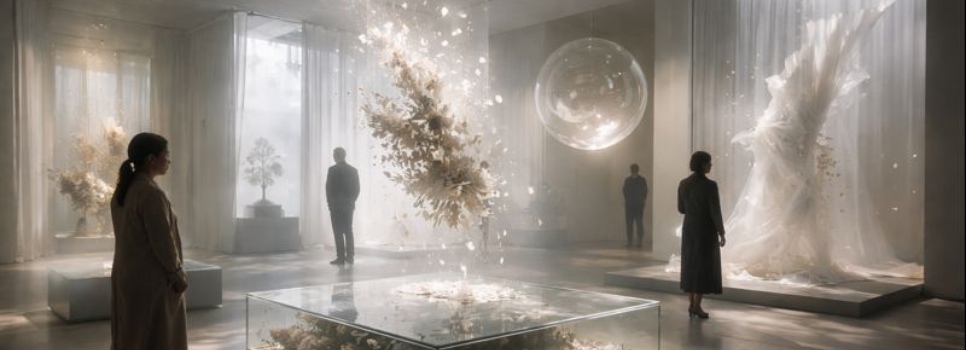
Light and material are central to Winterling’s explorations of perception. Her installations often use natural or artificial light to highlight specific surfaces, textures, or forms, subtly altering how the work is perceived. Materials are chosen for their capacity to reflect, absorb, or diffuse light, creating an interplay between the artwork, its environment, and the viewer.
These elements encourage a contemplative mode of engagement, where viewers become aware of their own perception and its role in shaping the experience of art. Winterling’s work highlights how even minor variations in context can dramatically influence the interpretation of a piece.
Themes and Concepts
Winterling frequently investigates themes of memory, transformation, and temporality. Her art captures the transient nature of perception and the ways in which human experience is constantly evolving. By creating work that shifts with light, perspective, and time, she emphasizes the fluidity of experience and challenges audiences to remain attentive to subtle changes.
Her projects also explore the boundaries between visibility and invisibility, presence and absence. By manipulating perception, Winterling invites viewers to question what is seen, what is overlooked, and how meaning is constructed through observation.
Critical Reception and Impact
Susanne Winterling’s work has been recognized for its intellectual depth and sensory subtlety. Critics and audiences praise her ability to create immersive experiences that are both visually compelling and conceptually rich. Her art engages viewers in active reflection, encouraging a heightened awareness of perception, memory, and the surrounding environment.
Experiencing Winterling’s Art
In Winterling's case, the viewer traveling upon his or her artworks must proceed with a certain deliberateness and patience. Exhibition design is often far-reaching. The venues made available for movement, observation, and reflection are conducive to presenting an ideaal set of perspectives. In turn, through time, these vantage points shall start consolidating into knowledge, which will dissolve layers and thereby present a subline of the other, transforming perception into experience-into meaning mediated through one's interaction with the work.